 Danish
From Rubble to Resilience: Malak Shir Wali’s Story of Survival and Hope
When the ground shook that night, it wasn’t just the earth that broke; it was lives, families, and dreams.
It was midnight in the quiet mountains of the Nurgal district when the devastating earthquake struck. In a few seconds, homes that had stood for generations crumbled into dust. Mothers called for their children in the darkness. Brothers shouted their sisters’ names into the cold night air. Fathers searched desperately for their sons. But there was only silence, heavy, painful, and endless.
Among the survivors was Malak Shir Wali, a humble farmer and the only breadwinner of his nine-member family. His right hand, already weakened from an old injury during the civil war, trembled as he tried to dig through the rubble with his bare hands. “We couldn’t even recognize our own village anymore,” he recalled, his eyes glistening. “It looked like doomsday had arrived. We didn’t know who was under the earth and who had survived.”
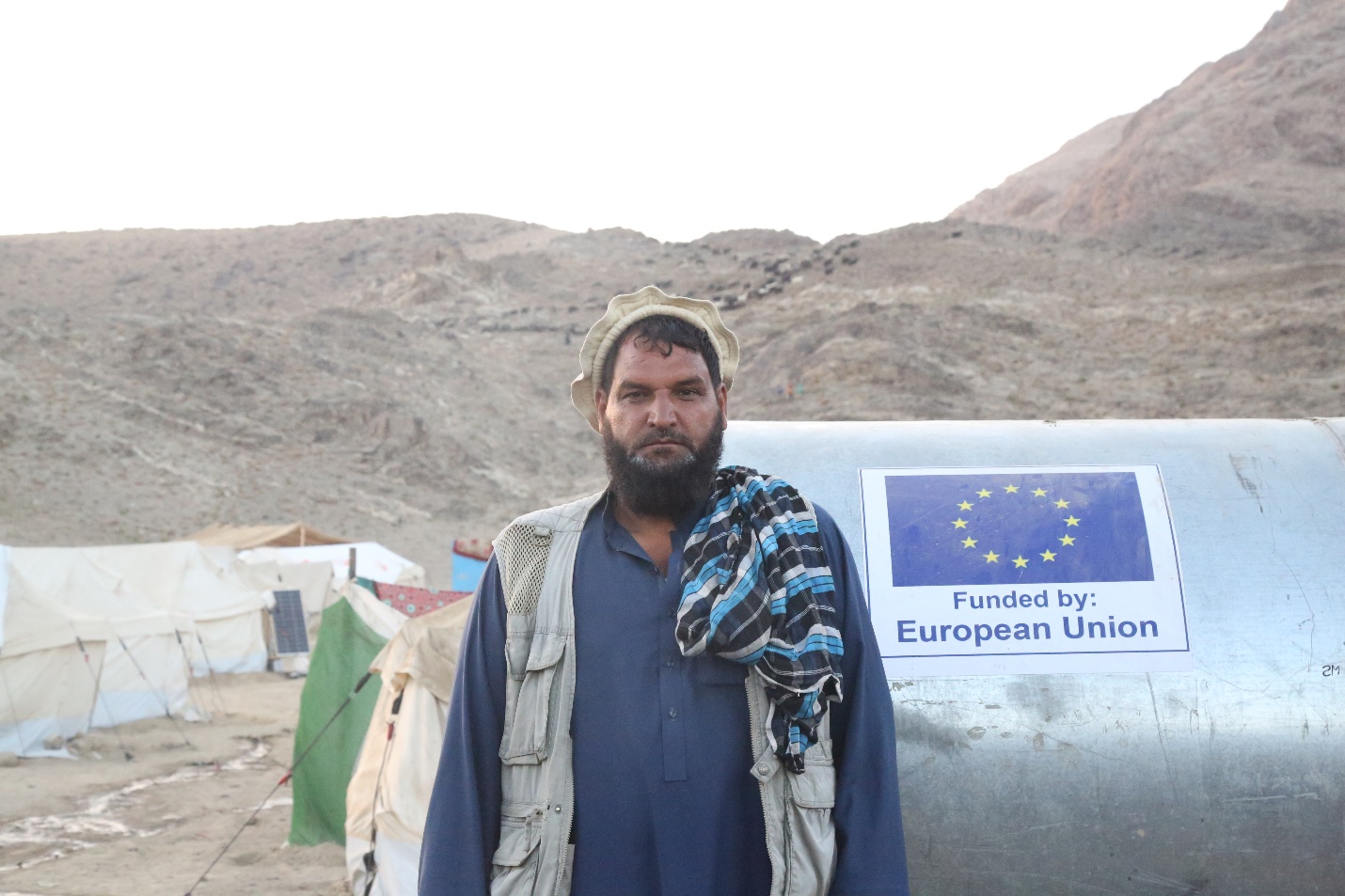
Malak Shir Wali stands in front of a water tanker installed by DACAAR
The family lost everything that night: their home, their land, and even their small herd of goats that had sustained them. “Ten of my goats died,” said Shir Wali quietly. “I could only save thirty. But at that time, it was not about goats, it was about life itself.”
With nothing left, they fled to Zirri Baba Camp in the Nurgal district of Kunar province, joining hundreds of other displaced families searching for safety, food, and hope. But the camp, in its early days, offered little. “There was no clean water, no food, no shelter,” Shir Wali said. “We were lost; frightened of what had happened, and afraid of what was to come.”
That is when DACAAR, with the generous support of the European Union (EU), arrived (https://civil-protection-humanitarian-aid.ec.europa.eu/index_en). Their Emergency Earthquake Response Project became a lifeline for the shattered community.
DACAAR’s teams worked tirelessly to restore dignity in the camp. They installed 100 latrines and 100 baths, ensuring privacy and sanitation for the displaced families. They distributed 791 hygiene kits, set up 15 hand-washing facilities, and placed 30 dustbins to keep the camp clean. For families like Shir Wali’s, access to 52,500 liters of safe water daily was nothing short of a blessing. “Before DACAAR’s help, we drank whatever water we found,” he shared. “Now, we have clean water, and it has saved our children from many diseases.”
Three hygiene promotion sessions were also conducted, helping families understand how to protect themselves from outbreaks of illness in such difficult conditions. “The sessions changed the way we live,” Shir Wali smiled. “Now, even my youngest son reminds others to wash their hands before eating.”
DACAAR didn’t just bring water and hygiene; they brought hope. For Shir Wali, this support marked the beginning of recovery. “When everyone else was afraid to come, DACAAR stood beside us,” he said. “They gave us not just supplies, but strength to start again.”
Yet, challenges remain. As the harsh winter approaches, cold winds seep through the thin tents, and nights grow longer and colder. “We are grateful for all that DACAAR, and the EU have done,” Shir Wali said, his voice heavy with both gratitude and worry. “But we need proper shelters. We need electricity. We need warmth for our children.”
Despite the pain and uncertainty, Malak Shir Wali refuses to give up. Each morning, he looks at his family: alive, together, and still smiling, and finds courage. “The earthquake destroyed our homes,” he said, “but not our hope.”
And that hope, now watered by compassion and care, continues to grow in Zirri Baba Camp, where every drop of clean water, every act of kindness, and every shared smile is a step toward rebuilding life from the rubble.
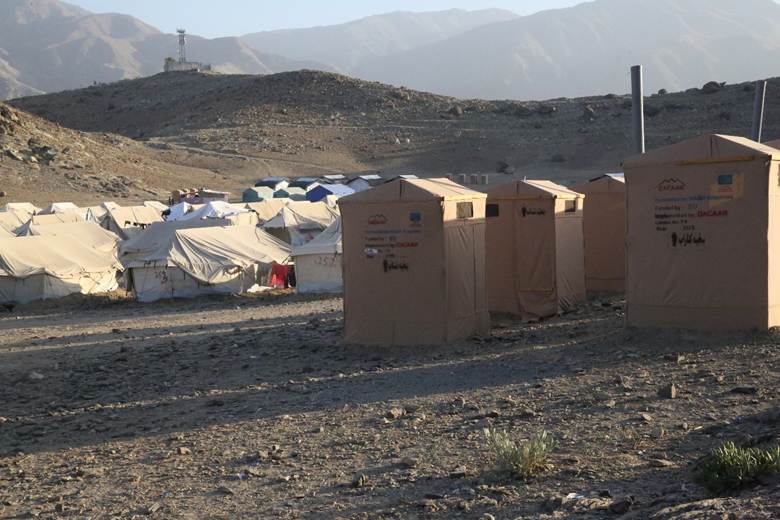
EBLs installed by DACAAR in the Zirri Baba Camp